
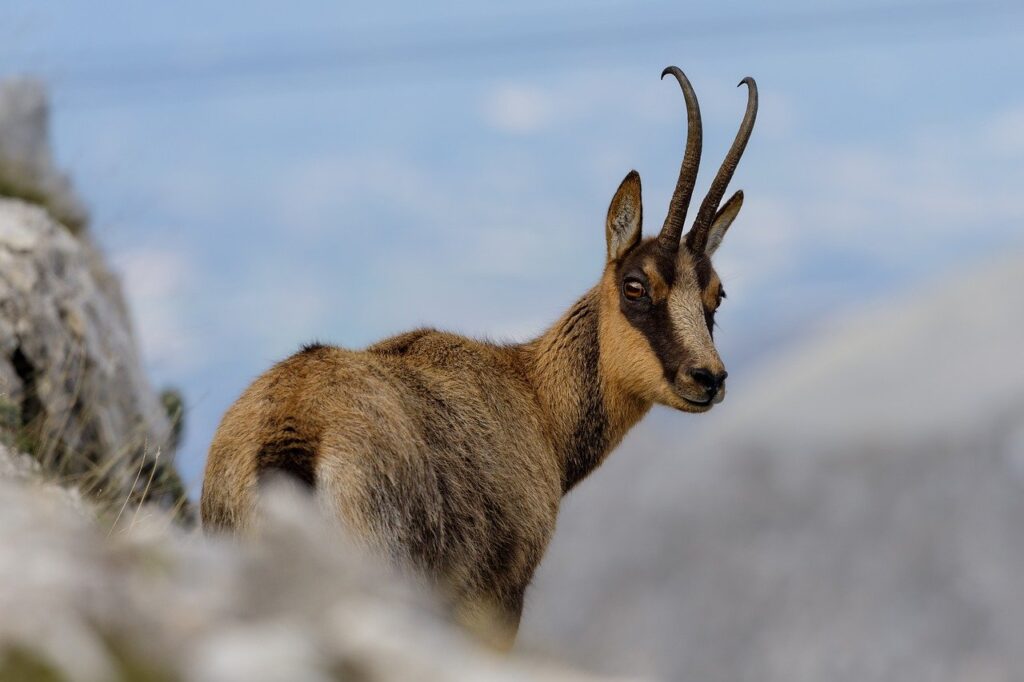

Among Europe’s most agile and iconic mountain dwellers, the chamois (Rupicapra spp.) has staged an impressive return from steep population declines. Once impacted by habitat loss, human development, and competition with livestock, chamois numbers have rebounded dramatically in recent decades. Across Europe, their total population now exceeds 400,000. A standout success story comes from the Tatra Mountains, where their numbers rose from just 160 individuals in 2000 to over 1,400 by 2018 – an incredible 800% increase in less than two decades.
These nimble, goat-like animals are built for extreme terrain. Standing about 31 inches at the shoulder and weighing up to 110 pounds, chamois are renowned for their agility. They can leap nearly 20 feet in a single bound and scale rocky cliffs with ease. Their distinctive dark facial stripes, backward-curving horns, and seasonal coats – pale brown in summer, thick and dark in winter – make them well-suited to life across the Pyrenees, Alps, Carpathians, Caucasus, and other rugged ranges.
Chamois are also fascinating in their social lives. Females and young form small herds, while males are more solitary outside of mating season. During the rut, males don’t engage in direct fights – instead, they race each other along cliff edges to establish dominance. After a 21-week gestation, a single kid is born, already remarkably steady on steep ground.
Beyond their biological adaptations, chamois hold cultural significance. They are the national animal of Slovenia and appear on the Slovenian coat of arms, symbolizing resilience and grace. They’re also featured in Slovenian folklore and alpine heritage.
In addition to population monitoring and habitat protection, chamois have even been introduced outside their native range. For example, they were brought to New Zealand in the early 1900s, where they now maintain a wild population – though their presence there raises separate ecological questions.
RELEVANT READING | From Extinction to Endangered: The Scimitar-Horned Oryx’s Historic Comeback
Today, conservation efforts focus on maintaining genetic diversity, monitoring for disease, and reducing conflicts as alpine areas become increasingly popular for recreation and grazing. Thanks to consistent protection and management, many chamois populations remain stable or are growing.
Take-away:
The chamois recovery in the Tatra Mountains – an eightfold increase in less than 20 years – shows how targeted conservation can deliver extraordinary results. It’s a clear example of how mountain species can thrive when given the chance.