
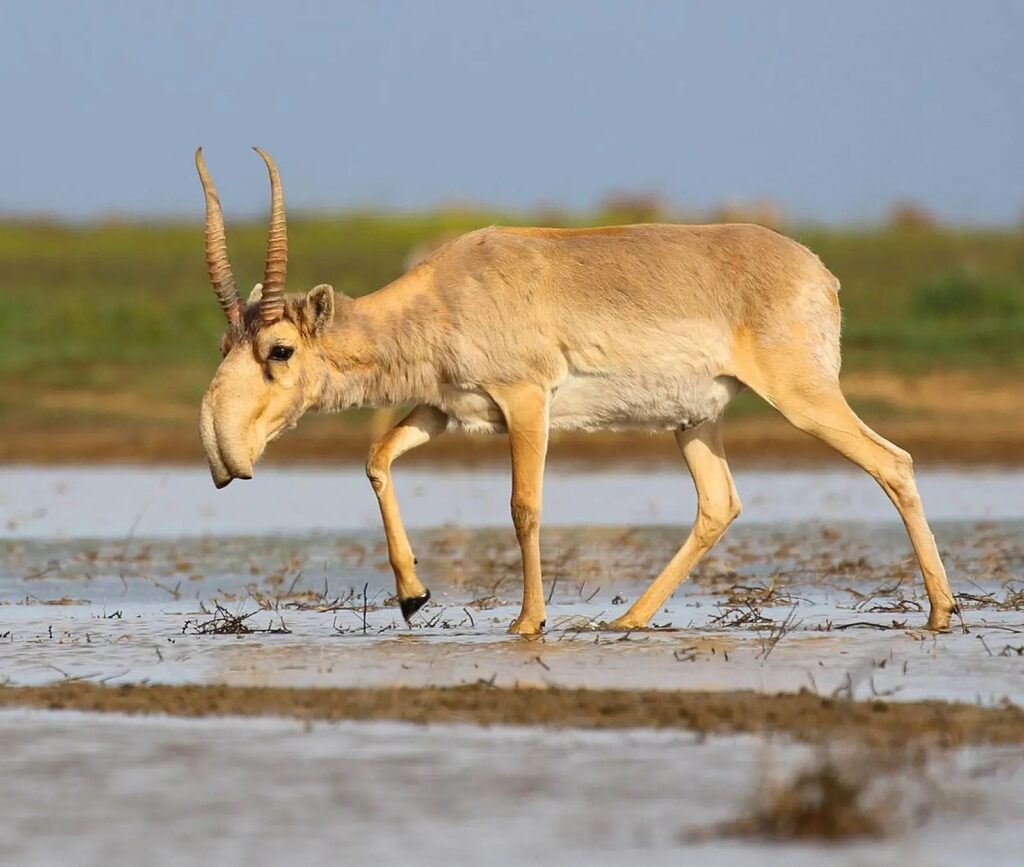

With its distinctive bulbous nose and prehistoric appearance, the Saiga tatarica is one of the most unusual and ancient antelopes on Earth. Once roaming alongside mammoths and saber-toothed cats, the saiga evolved over millions of years to survive the harsh climates of the Eurasian steppes. Its flexible, trunk-like snout helps filter dust in the summer and warm frigid air in the winter – a unique adaptation to life on the open plains. Historically ranging from Western Europe to North America, the saiga’s modern stronghold is now limited to parts of Central Asia. This evolutionary relic isn’t just biologically fascinating – it’s ecologically vital. As a migratory grazer, the saiga plays a key role in shaping steppe ecosystems, making its conservation critical not only for biodiversity but for the health of an entire biome.
Just two decades ago, the floppy‑nosed saiga antelope was on life support. By 2003, only 6 percent of its once‑vast herds remained across Kazakhstan, Mongolia, Russia, and Uzbekistan, after collapsing economies and disease pushed the species to the brink. Today, the astonishing turnaround has propelled the population to approximately 1.9 million across Eurasia – a monumental rebound that prompted the IUCN to shift the saiga’s status from Critically Endangered to Near Threatened.
In the mid‑1990s, saiga numbers crashed by over 90 percent in just a few years, marking one of the steepest declines recorded for any mammal. The collapse reflected a perfect storm: demand for saiga horn in traditional medicine markets in East Asia increased just as economic turmoil made the steppe a perilous place. Additionally, fragmentation of migratory routes – fenced borders, infrastructure – and a lethal disease outbreak in 2015 that wiped out more than half of the global population dealt devastating blows.
Yet behind those grim numbers lies a powerful story of coordinated conservation action: toward the end of 2006, range countries – including Kazakhstan, Uzbekistan, Mongolia, and Russia – signed an MoU with stakeholder nations like the U.S., committing to habitat restoration and sustainable use. Kazakhstan ramped up enforcement on the ground – providing rangers with fuel, gear, and shelters – and cracked down on illegal wildlife trade, while designating over 12 million acres of protected habitat.
Local attitudes shifted, too. As economic stability returned, people on the steppe began to view the saiga not as a resource, but as a symbol of wild freedom – one they wanted to protect. This cultural shift, paired with strong institutional collaboration, helped fuel the population rise – from about 48,000 in 2005 to 1.9 million now.
Despite the optimism, the story isn’t over. The saiga remain vulnerable. The IUCN’s classification reflects that, noting the species could quickly tumble again in the face of disease, infrastructure threats, or renewed exploitation. Here’s the takeaway: this isn’t just a conservation success – it’s a cautionary tale wrapped in triumph. Nearly lost, almost forgotten, the saiga’s recovery shows that resilient species – and bold, sustained efforts – can deliver real wins. But the momentum must be maintained.
Memorable takeaway: In just 20 years, saiga numbers surged from a few tens of thousands to nearly 2 million. That’s not just hope restored. It’s a vivid reminder: when communities, conservationists, and governments unite, even the most endangered species can find their way back from the edge.