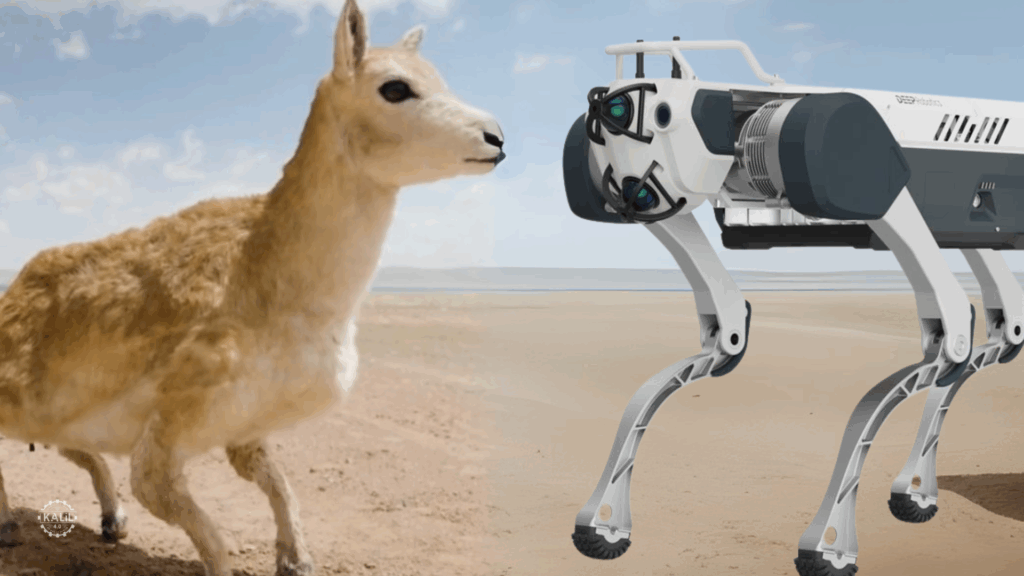

High on the windswept Qinghai‑Tibet Plateau, where the air is thin and human presence triggers alarm, a lone antelope moved silently among the herd. It grazed, observed, and kept pace across more than 1.2 miles of rugged terrain – but it wasn’t alive. It was a robot.
This isn’t science fiction – it’s a groundbreaking experiment in conservation technology. Scientists have successfully deployed a robotic Tibetan antelope, developed in collaboration with DEEP Robotics, to observe wild herds without being detected. Equipped with 5G networks, artificial intelligence, and a lifelike design, the robot blends in seamlessly, capturing critical behavioral data in one of the planet’s most fragile ecosystems.
Challenges & Innovation
These mountain-dwelling antelopes are incredibly sensitive to disturbance: even a human observer as far away as 1,600 to 2,600 feet can cause stress responses, especially in pregnant females. Traditional observation methods – binoculars, remote cameras, and drones – fall short. They often either spook the animals, offer limited observation windows, or miss nuanced behaviors.
The robotic antelope, however, is built on a quadruped robot platform, covered in synthetic fur and colored to resemble real antelopes. During field trials in late July, it traversed more than 1.2 miles of rugged terrain – open ground, steep slopes, and marshlands – without startling the herd. The robot integrated into the group and successfully recorded grazing behavior, executing “non-intrusive filming tasks” in real time.
What This Means for Population Monitoring & Conservation
Historically targeted for their under-fur, the Tibetan antelope species saw its population dwindle to around 65,000 by the 1990s. Thanks to conservation efforts, the population has rebounded to an estimated 100,000 to 150,000 today. With this recovery comes a new challenge: how to monitor larger populations in remote, fragile ecosystems without causing harm or disruption.
This robot provides a promising solution. It collects detailed, reliable, and close-range data while minimizing human disturbance. It allows researchers to study behaviors that might otherwise go unseen or unrecorded.
Similar Innovations Closer to Home
Across the globe, researchers in the United States are exploring similar frontiers. At Mississippi State University, scientists have been testing autonomous cattle-herding robots that could transform livestock management. These robots are being trained to manage and move cattle without stressing the animals – offering benefits in both animal welfare and farm labor. Early findings suggest that livestock may actually respond better to robotic herders than to human ones, potentially reducing incidents of stress-related illness and injury among animals.
Meanwhile, at UC Davis, a more ecological application is underway. Researchers there have deployed robotic birds to study the mating behaviors of greater sage-grouse, a species known for its elaborate courtship displays. By introducing robotic grouse into real mating arenas, scientists can observe reactions and interactions without introducing disruptive human presence. This not only sheds light on complex behavioral ecology but also opens the door for more accurate conservation assessments.
Take‑Away: Why the Robot Matters
What stands out is this: in one real-world trial, a robot traveled over a mile into remote high-altitude terrain, moved among wild antelopes without alarming them, and gathered meaningful behavioral data. This isn’t just a lab prototype – it’s a tool already proving its value in the field. For conservationists, it represents new potential for ethical and effective monitoring of sensitive species.
RELEVANT READING | Community-Based Wildlife Management in Central Asia
Final Thoughts
Whether on windswept American rangelands or high mountain ecosystems, one truth is emerging: robotics can offer a revolutionary way to study, monitor, and manage wildlife without causing harm. By designing machines that move with the rhythm of nature rather than against it, researchers can unlock new insights while preserving the delicate balance of wild places.