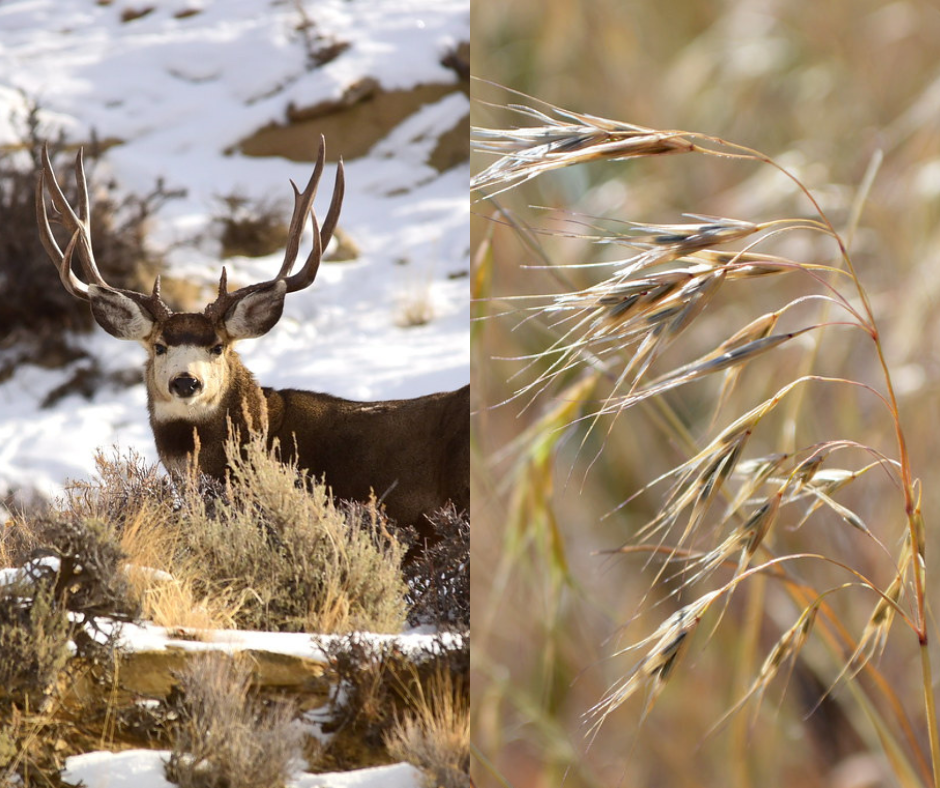

A new study out of the University of Wyoming reveals a startling trend: when cheatgrass covers just over 20 percent of the terrain, mule deer outright avoid those areas. The research – conducted by UW professors Jerod Merkle and Brian Mealor along with research scientist Kurt Smith, using GPS data and vegetation mapping in northeast Wyoming – shows clear patterns of avoidance tied directly to cheatgrass abundance.
The study focused on mule deer habitat in northeast Wyoming, an area vital for big-game wildlife and sagebrush ecosystems. Its importance lies not only in its current biodiversity but also in its role as winter range and migration corridor for mule deer and other species – making it a critical front in conservation efforts.
Cheatgrass poses a serious problem. Unlike native grasses, it springs up early, dries out fast, and becomes extremely flammable – turning rangelands into tinderboxes by early summer. After fire, it spreads more aggressively, displacing shrubs like sagebrush and bitterbrush that mule deer rely on for both food and cover. This creates a destructive cycle where invading cheatgrass fuels further fire and habitat degradation.
Researchers tracked 115 GPS-collared mule deer and overlaid their movement patterns with cheatgrass coverage maps. Browse rates began declining at 10–16 percent cheatgrass, and areas with more than 20 percent were completely avoided.
This loss compounds other threats already contributing to mule deer declines in Wyoming – energy development, drought, disrupted migration routes, and barriers like roads and fences.
Fortunately, the study offers hope. Land managers are using targeted herbicide treatments – particularly with Rejuvra – which suppress cheatgrass without harming native perennial plants. Once treated, mule deer return and usable habitat is restored.
Why Northeast Wyoming Should Matter to People
- Ecological significance: This region supports key wildlife populations – mule deer, sage grouse, songbirds, even reptiles.
- Fire risk reduction: Tackling cheatgrass could significantly lower wildfire frequency and intensity, benefiting both ecosystems and nearby communities.
- Biodiversity and resilience: Intact sagebrush rangelands are essential not just for mule deer, but for broader ecosystem health and stability.
Additional Evidence: Rejuvra’s Broader Impact
Beyond the university study, other restoration efforts highlight Rejuvra’s effectiveness – and its implications for mule deer and similar wildlife:
- In Boulder County (Colorado), treating cheatgrass-infested rangelands with Rejuvra resulted in:
- A 1.5–2.8× increase in shrub leader growth (key winter forage for mule deer and elk)
- A 4–5× boost in perennial grass biomass
- 92% reduction in cheatgrass litter within 8 months, and near-elimination by 20 months post-application.
- In the Wind River Reservation (Wyoming), a collaborative restoration project among tribes, USFWS, BIA, and local stakeholders identified over 10,000 acres for aerial treatment with Rejuvra. The herbicide proved highly effective, reducing annual invasive grasses by up to 98 percent. Importantly, this area serves as a valuable winter range for mule deer, elk, and bighorn sheep – underscoring both ecological and cultural stakes.
RELEVANT READING | Mule Deer Conservation: Protecting a Western Icon
Takeaway for Conservation Frontlines
If cheatgrass continues to expand unchecked, mule deer in northeast Wyoming could lose up to half of their usable habitat. But the science is clear: targeted, strategic use of herbicides like Rejuvra can reverse this trend – restoring habitat and bringing mule deer back.
This fight matters not just for the deer, but for the overall health of Wyoming’s landscapes – and for preserving the wildness and biodiversity that define it.
Supporting Solutions: The Mule Deer Foundation
The Mule Deer Foundation is the only organization focused solely on conserving mule deer and their habitat. Through science-based projects, they’ve helped restore hundreds of thousands of acres affected by threats like cheatgrass. By partnering with agencies and local communities, MDF is playing a key role in protecting migration corridors, improving winter range, and ensuring a future for mule deer across the West. Learn more at muledeer.org.