
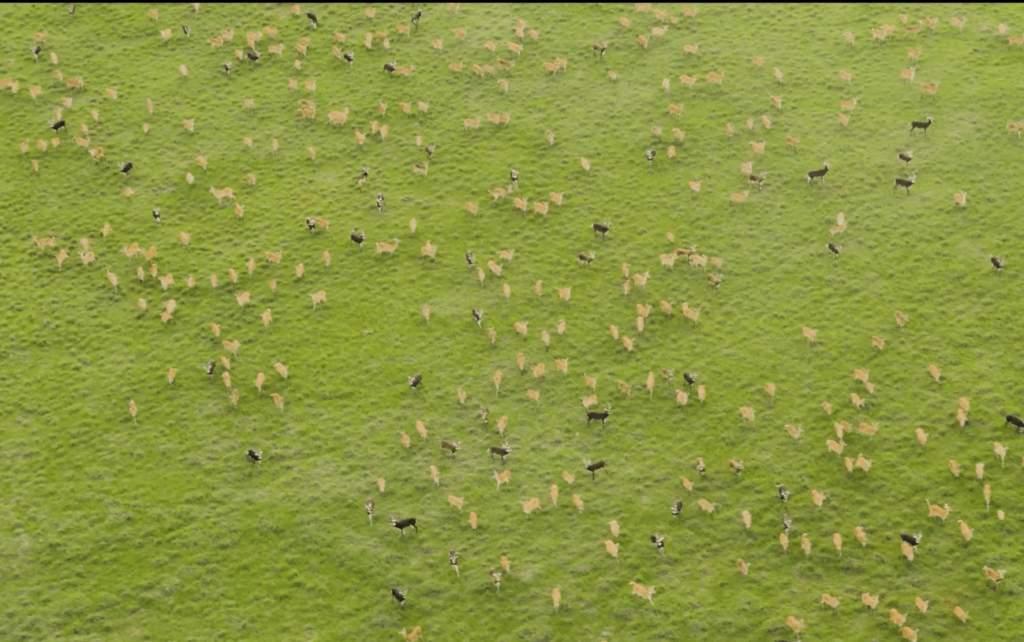

Imagine a herd so vast that from the air it looks like a river of animals carving a path through the savanna. South Sudan is home to exactly that: an estimated 6 million migratory antelope participating in what is now confirmed to be the largest land mammal migration on Earth.
A recent aerial survey of the Boma-Badingilo Jonglei Landscape (BBJL) – a massive ecosystem covering nearly 47,500 square miles (about the size of Pennsylvania) – counted approximately 5,089,000 white-eared kob, 346,000 Mongalla gazelle, 299,000 tiang, and 162,000 Bohor reedbuck. Together, these four species number around 5.9 million ±1 million animals.
For perspective, the famous Serengeti migration involves around 1.3 to 2 million animals. That means South Sudan’s migration is roughly three to four times larger, making it a globally significant wildlife event – and one that few have heard of.
Why It Matters – and What’s at Risk
This migration is not only a breathtaking natural event; it’s also a lifeline for ecosystems and people. The migration routes stretch across hundreds of miles, reaching into Ethiopia’s Gambella National Park and connecting the floodplain grasslands with the wetlands of the White Nile. These pathways support food security, grazing cycles, and biodiversity across East-Central Africa.
But while the migratory species appear to be holding strong, non-migratory wildlife – such as elephants, buffalo, hippos, and cheetahs – have declined dramatically since earlier surveys in the 1980s. That’s a major red flag. Several factors have contributed to this loss: decades of civil war and political instability disrupted conservation work and made many protected areas inaccessible; increased availability of firearms during the conflict weakened protections for wildlife; and prolonged displacement of communities put added pressure on natural resources. At the same time, chronic underfunding left parks without enough staff, equipment, or infrastructure to monitor and safeguard vulnerable species. The lasting effects of conflict, paired with ongoing challenges like habitat fragmentation, infrastructure development, and weak enforcement, continue to threaten the region’s resident wildlife.
Other pressures are rising fast. A surge in wildlife trafficking, road development, oil and mining expansion, and a lack of law enforcement outside protected zones are placing immense strain on this ecosystem. Many park rangers operate with little or no pay. During the dry season of 2023 alone, an estimated 30,000 antelope were killed each month in high-risk areas, according to conservation groups.
Takeaway: A Migration at a Crossroads
South Sudan’s Great Nile Migration is a global treasure – now confirmed as the largest land mammal migration on the planet. But sheer size is no guarantee of survival. Without immediate action to protect the land, enforce wildlife laws, and support communities, this ancient migration could quietly collapse.
Here’s what we must take away:
- This migration is 3–4 times larger than the Serengeti’s, yet receives a fraction of the attention.
- Migratory species are surviving. Stationary species are vanishing. That contrast is a warning.
- Solutions exist: better ranger funding, smarter land-use planning, and community-led stewardship.
We now have the data to prove this migration’s scale. What happens next depends on whether the world pays attention – and invests in its future.