
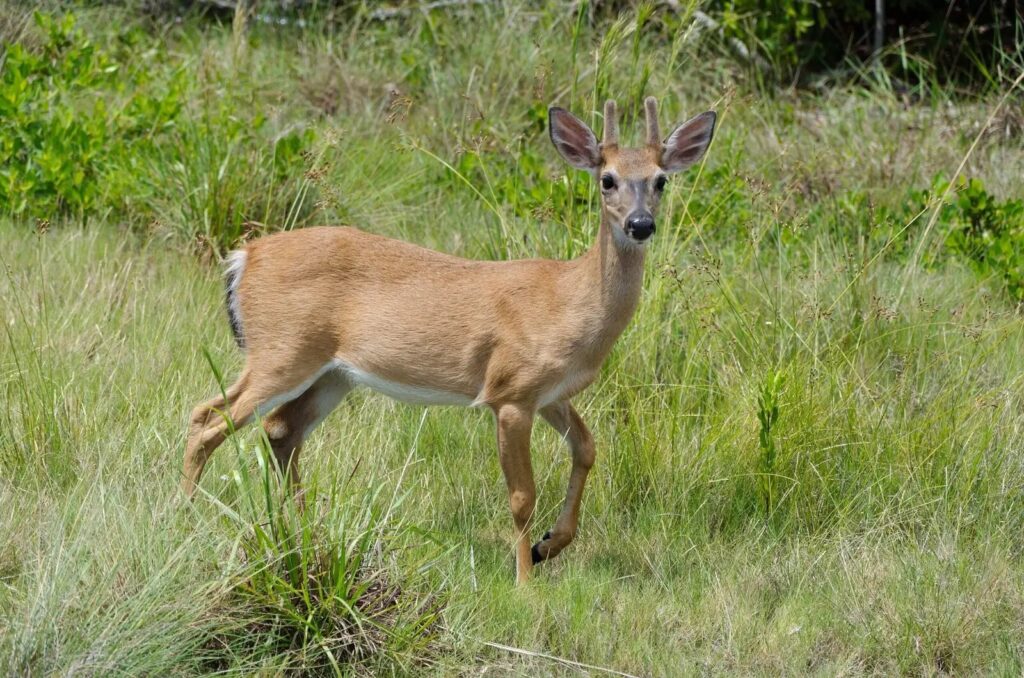

Fewer than 1,000 Key Deer survive today, making them North America’s rarest and smallest deer. Standing just 30 inches tall and weighing under 80 pounds, these tiny deer live exclusively on a narrow chain of islands in Florida. Their story is one of near extinction, remarkable recovery, and ongoing challenges from hurricanes, rising seas, and habitat loss, highlighting the critical conservation efforts working to ensure their survival.
Most of the Keys rise only about three feet above sea level, leaving deer vulnerable to storms and flooding. Severe hurricanes in recent years have inundated their low-lying habitat, washing away food and freshwater sources. During dry seasons, biologists have observed Key deer drinking from puddles and roadside ditches as their natural water supplies vanish.
The species’ decline was steep. By the 1950s, poaching and development had pushed the population to fewer than 30 deer. The creation of the National Key Deer Refuge in 1957 allowed numbers to steadily rebound to roughly 800–1,000 today. The refuge protects about 9,200 acres of habitat, but even small increases in sea level could shrink that protected space by thousands of acres, intensifying competition for food and forcing deer closer to roads – where vehicle collisions are a leading cause of death.
Conservation teams work tirelessly to restore native vegetation, manage disease, and track deer movement across the islands. A 2016 outbreak of screwworm flies killed over 130 deer, yet swift intervention prevented the population from collapsing. This demonstrates how focused, proactive management can still make a critical difference.
Takeaway: The Key deer’s story is one of resilience. From near extinction to recovery, these tiny deer have adapted to one of the harshest environments imaginable. Their continued survival depends on protecting freshwater sources and native vegetation, holding on to the last dry ground in their island paradise.