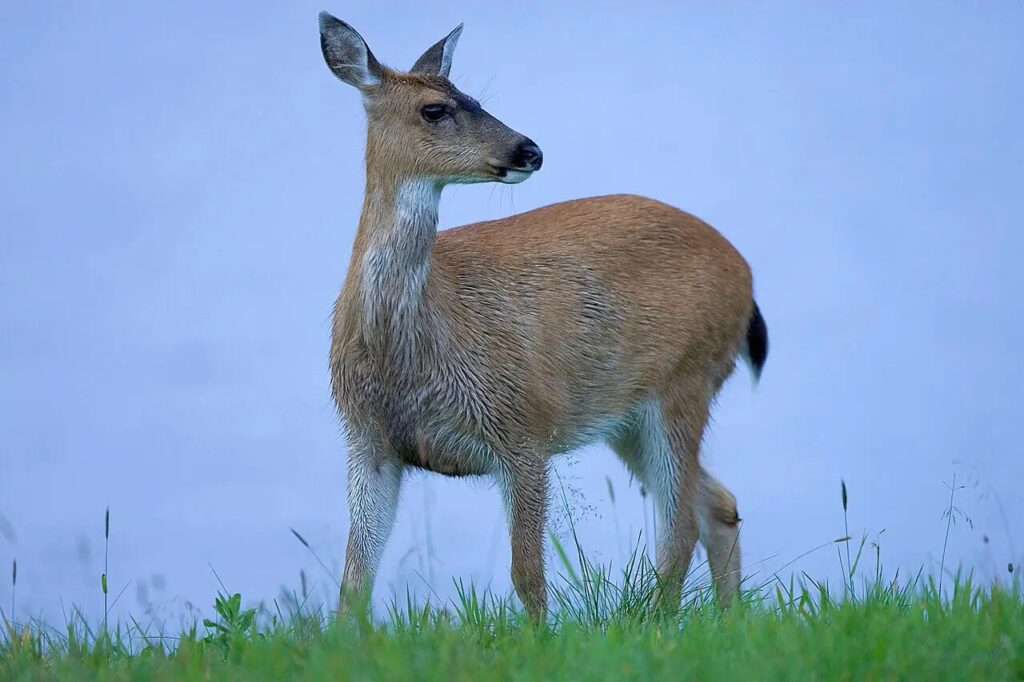

Wildfires are critical and positive for black-tailed deer, playing a key ecological role in maintaining the balance of their habitat. These fires rejuvenate the landscape by clearing old vegetation and promoting new, nutrient-rich growth that deer rely on for food and cover. Studying how wildfire shapes this cycle of disturbance and renewal helps us better understand the overall health of western forest ecosystems.
The Columbian black-tailed deer are a subspecies of mule deer. Black-tailed deer thrive in rugged, coastal terrain and thick underbrush. They are remarkably adaptable, feeding on a wide range of plants. However, unburned forests with little sunlight reaching the ground leads to minimal forage. This forces deer to travel farther and work harder to find food.
Low-intensity wildfires play a vital role in keeping forests healthy and diverse. These natural fires clear out dense brush and dead vegetation, opening up the forest canopy to sunlight. This allows new plants to grow, providing deer with fresh, nutrient-rich food and better visibility for foraging. Studies show that after moderate burns, deer populations often increase. The renewed vegetation offers ideal feeding and cover conditions.
Decades of aggressive fire suppression have altered that balance. Without periodic burning, many forests have become overly thick with mature trees. For deer, this means less food and more energy spent searching for it. However, when fires burn too hot or over large areas, the loss of canopy and cover leaves deer exposed to predators and harsh weather.
The key is scale and timing. A mix of burned and unburned patches across the landscape provides high-quality forage and secure cover. Modern land managers aim for that balance through prescribed burns and selective thinning. These practices mimic the natural fire cycles once maintained by lightning and Indigenous stewardship.
RELEVANT READ | Protecting Pennsylvania’s Crops: Solutions to the Growing Deer Damage
The Blacktail Deer Foundation plays a crucial role in this work. They work to ensure black-tailed deer and their ecosystems remain resilient in an era of climate-driven change. Their efforts remind us that when managed carefully, fire doesn’t just destroy – it renews.
Takeaway: Wildfire is a double-edged sword for black-tailed deer. Moderate, well-managed burns can restore the open, diverse habitats they depend on. Intense, widespread fires can strip away critical cover. Supporting sound forest management and conservation groups is essential to keeping black-tailed deer and their forests thriving for generations to come.