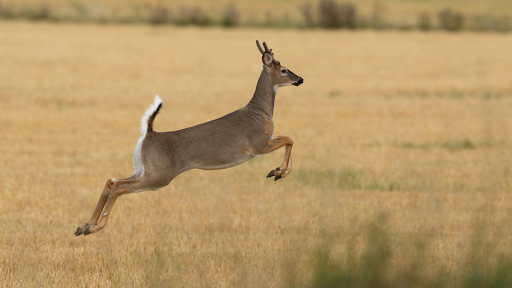

If you live in suburban New York, you have probably seen one. Maybe it crossed your street at dusk. Maybe it was eating your landscaping.
White tailed deer are no longer distant wilderness animals. In many urban and suburban regions, they have become what ecologists call a synanthropic species, wildlife that benefits from and adapts to human dominated environments.
The White-tailed deer is the most widespread large mammal in North America.
With fewer natural predators and abundant landscaping plants, neighborhoods often function as high nutrition habitats. The result:
• Overbrowsed native vegetation
• Increased vehicle collisions
• Tick and disease concerns
• Strain on local plant diversity
For many urban residents, deer appear either harmless and beautiful or frustrating and overabundant. Their presence is not random. It reflects how deer adapt to human landscapes.
And it begins with what deer eat.
What Deer Really Eat
At a glance, deer appear to graze casually. In reality, they are highly selective feeders. Their four-chambered stomach allows them to extract nutrients efficiently, and their feeding behavior shifts with the seasons based on plant chemistry and energy return.
As explained in the episode “What Deer Really Eat and Why It Matters” from the Whitetail EDU series, deer do not simply eat what is available. They seek the highest nutritional payoff at any given time of year.
Suburban landscapes often provide exactly that. Ornamental shrubs, irrigated lawns, garden beds, and fragmented edge habitat offer consistent, high quality forage. In many regions, residential neighborhoods provide more stable nutrition than surrounding forests.
To a deer, your yard can function as a prime habitat.
Why That Matters
When landscapes consistently provide high quality nutrition, reproductive success increases. Well fed does produce healthier fawns. More fawns survive. Herd size grows.
In forests and rural landscapes, predators and habitat limitations regulate that growth. In many urban areas, those controls are reduced. The result is heavier browsing on plants, fewer young trees, and changes in which plants survive.
What deer eat influences what neighborhoods and forests become.
The Bigger Picture
White tailed deer are one of North America’s major wildlife recovery stories. In many metropolitan regions today, they have adapted extremely well to human landscapes.
They are not wandering into cities by accident. They are responding to reliable food, safe cover, and fewer predators.
Understanding what deer eat helps explain why they live where you live.
The Takeaway
Deer are not just backyard visitors. They are synanthropic wildlife, species that have learned to live with us.
And it begins with the food the deer eat.