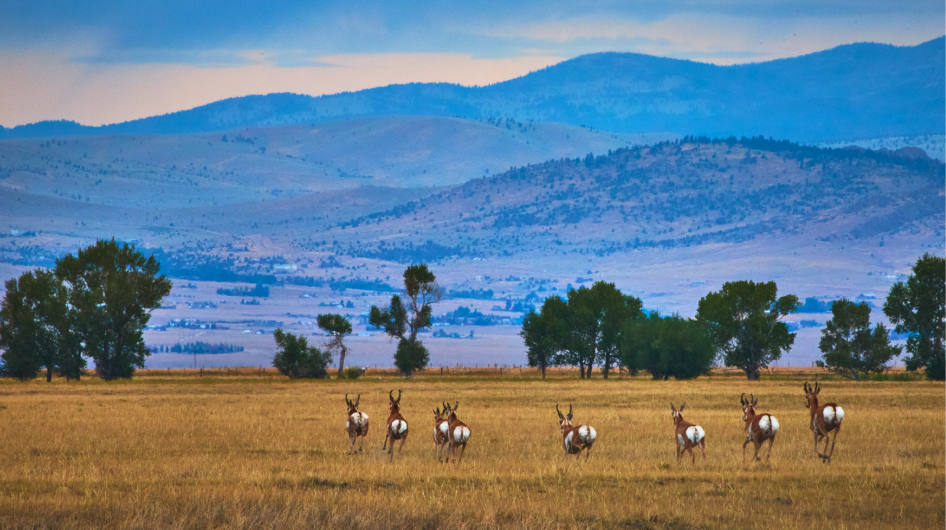

For decades, wildlife scientists have documented one of North America’s most extraordinary animal movements: the Sublette pronghorn migration, a continuous pathway stretching roughly 180 miles across western Wyoming from the Green River Basin toward the Tetons and beyond.
This spring, after nearly seven years of study and debate, Wyoming has taken a critical step in forming a working group of local stakeholders to review how that migration corridor should be managed going forward.
This isn’t a routine check-in. It’s the first time the state’s migration policy is being tested from start to finish, combining hard science, economic interests, and land use questions into a process with real implications for wildlife and people.
Why This Migration Matters
The Sublette pronghorn migration is unique not just for its distance, but for its continuity and dependency on wide open landscapes. The tens of thousands of pronghorn that follow it do so because the route gives them reliable access to seasonal habitat. That pathway was shaped long before modern infrastructure and is central to the herd’s survival. In the summer, they move to higher elevations where temperatures are cooler and forage is better. In the winter, they shift to lower elevations where snow is lighter and food is more accessible. The route between those seasonal ranges allows them to reach both.
It’s not random movement. It’s a survival system.
If that pathway stays open, pronghorn can access food, avoid deep snow, and reduce stress during harsh months. If the route is blocked or disrupted, they may not be able to reach those critical seasonal habitats, which can directly impact body condition, reproduction, and overall herd health.
The corridor crosses roughly 2.3 million acres, including critically narrow segments called bottlenecks where a fence, road, or other development could effectively cut off the migration. Scientists and state wildlife officials see pronghorn migrations as one of the best indicators of how well western landscapes are functioning.
What the Working Group Is Doing
Wyoming Gov. Mark Gordon appointed an 11-member working group representing diverse interests: county officials, oil and gas, agriculture, conservation, hunting groups, and recreation.
Their task is to:
- Review a 150-page scientific biological risk assessment of the corridor.
- Evaluate the components of the 2.3 million-acre mapped migration route, including high-use areas and narrow bottlenecks.
- Consider social and economic impacts of designating or modifying the corridor.
How the group will reach recommendations, by majority vote, consensus, or otherwise, has not yet been established. Their work is advisory. Once they finish their review and submit recommendations, the decision goes to Wyoming Gov. Mark Gordon.
He has the authority to:
- Approve the corridor as proposed
- Modify the boundaries
- Adjust management guidelines
- Or decline to designate it under the state’s migration policy
So the group debates and advises. The governor decides.
Why Now?
Wyoming wildlife managers and scientists have pushed for migration designation for years. The corridor has long been mapped and studied, but under the state’s migration policy, established in 2020, it has never been formally designated.
This review represents the first full application of that policy. It is a test case for how wildlife movement can be balanced with ranching, energy development, private land ownership, and other land uses that define the modern West.
Conservation Takeaway
Migration is more than an animal trek across a map. It is a sign of whether landscapes remain connected and functional in the face of increasing pressure.
The Sublette pronghorn migration is not just a Wyoming story. It’s a frontline example of how science, policy, and competing local interests intersect in efforts to keep wildlife moving in a rapidly changing world.
This review will set precedents, not just for pronghorn, but for how the West navigates conservation and development in the years ahead.