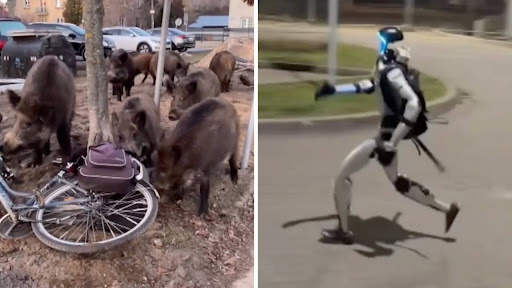

A clip out of Warsaw shows a humanoid robot moving down a residential street, pushing a group of wild boar back into the dark. It’s strange, a little funny, and it’s gone viral for that reason. But underneath the novelty is a signal conservation professionals recognize immediately: wildlife has adapted faster than the system designed to manage it.
The Situation on the Ground
The numbers tell the real story. Warsaw now has more than 3,000 wild boar moving through urban and suburban areas. Public reports have increased roughly twentyfold since 2020. In 2025 alone, there were 121 reported attacks on people and 341 boar killed by vehicles.
This isn’t a fringe issue anymore. It’s a full-scale human-wildlife conflict inside a major European capital.
City officials are now forming a task force to address it, with a clear mandate: reduce risk to residents while figuring out how to coexist with a species that has fully embraced urban life.
Why This Happens
Wild boar are one of the most adaptable large mammals in the world. They thrive in edge environments, reproduce quickly, and exploit food sources wherever they find them. Cities provide all three:
- Food abundance – trash, landscaping, and even direct feeding
- Mild microclimates – warmer conditions than surrounding countryside
- Limited pressure – no natural predators and restricted hunting
Once that equation tips, population growth isn’t linear. It compounds. What you’re seeing in Warsaw is not unique. It’s just visible.
The Optics vs. the Reality
A robot chasing a boar makes headlines. It feels innovative, maybe even futuristic. But it’s a surface-level response to a deeper issue.
Technology can assist. It can deter, monitor, and gather data. But it does not replace population management, habitat strategy, or policy alignment. Without those fundamentals, tools become temporary fixes.
The Conservation Reality
At its core, this is a management problem, not a novelty story. Effective wildlife management typically relies on three levers:
- Population control – regulated harvest, fertility control, or relocation where feasible
- Habitat pressure – limiting access to food and shelter in human-dominated areas
- Human behavior – public education and enforcement around feeding and waste
Urban environments complicate all three. Hunting is restricted. Public sentiment is mixed. Infrastructure works against control efforts. That’s where conflict escalates.
What This Signals Globally
Warsaw is an early indicator of a broader trend. As cities expand and landscapes fragment, species that can adapt will move in. Deer, coyotes, feral hogs, and other generalists are already doing this across North America. The difference between a manageable situation and a crisis comes down to timing. Act early, and it’s a planning conversation. Wait too long, and it becomes a safety issue.
Conservation Takeaway
This isn’t about a robot. It’s about a system struggling to keep pace with biology. Wildlife expands where food, cover, and pressure allow it; the real question is whether management acts early enough to control population growth and limit conflict. Right now, in Warsaw, it isn’t.