
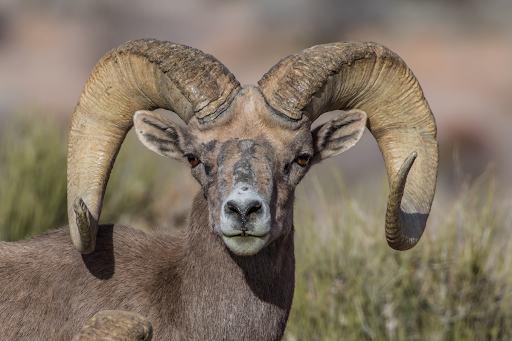

Desert bighorn sheep are one of North America’s most iconic mountain animals, built to survive in some of the harshest country on the continent. They’re defined by their heavy, curled horns, sharp eyesight, and ability to navigate steep, broken terrain where predators struggle to follow.
That specialization is also their vulnerability. While limited water sources and habitat fragmentation remain concerns, decades of human encroachment across the West have brought domestic sheep operations into closer proximity with desert bighorn habitat. The resulting transmission of respiratory diseases from domestic sheep is widely considered one of the most significant obstacles to long-term desert bighorn recovery, particularly in smaller and isolated herds.
Across the American Southwest, desert bighorn sheep are showing real signs of recovery—but it’s not uniform across the map. In states like Nevada, Arizona, and parts of California, populations are rebounding due to sustained conservation efforts and active management. However, in regions like Texas and parts of northern Mexico, recovery has been far more limited. There, introduced aoudad sheep occupy the same rugged terrain and compete directly with native bighorns, creating ongoing pressure that has made reestablishment difficult in certain areas.
Desert bighorn sheep once declined sharply across North America due to a combination of disease, habitat fragmentation, and water scarcity. One of the most significant long-term threats has been respiratory disease linked to contact with domestic sheep. According to the Nevada Department of Wildlife, disease transmission remains a primary factor limiting herd growth and stability in many regions. In some cases, entire populations were lost and unable to recover without direct intervention.
What’s changed in parts of the West is the level of intentional management.
Wildlife agencies, working alongside conservation groups like the Wild Sheep Foundation, have led aggressive translocation programs, capturing healthy animals from stable herds and relocating them into historic ranges where populations had disappeared. These efforts have reestablished herds across large portions of Nevada and Arizona, creating new population centers where none existed just decades ago.
Water development has also played a critical role. In desert environments, access to reliable water can determine whether a herd expands or disappears. Conservation programs have installed and maintained guzzlers, engineered systems that collect and store rainwater, allowing bighorns to occupy terrain that would otherwise be uninhabitable. The Nevada Department of Wildlife notes that these projects “expand available habitat and improve herd distribution,” directly contributing to population growth.
At the same time, land and wildlife managers have worked to reduce disease risk and competition pressures. In places where bighorn recovery is succeeding, there is often a clear effort to separate domestic livestock from wild sheep range and actively manage habitat conditions.
That level of control has not been consistent everywhere.
In Texas and parts of northern Mexico, introduced, non-native aoudad—also known as Barbary sheep (Ammotragus lervia)—have expanded rapidly across the same desert mountain ranges that bighorns depend on. Native to North Africa, where they’re commonly referred to as Barbary sheep, aoudad were brought to Texas in the mid-1900s by private ranchers and the Texas Parks and Wildlife Department for exotic game populations.
Research out of Texas Tech University has shown that aoudad and bighorn sheep compete for the same limited resources and are unlikely to coexist in the same landscape without conflict. Aoudad have also been identified as potential disease carriers, increasing the risk to already vulnerable bighorn herds.
As a result, recovery in these regions has lagged behind the broader Southwest. In some areas, active removal of aoudad is now part of the management strategy to give native bighorns a chance to persist.
The outcome across North America is a split picture: strong recovery where management is aggressive and coordinated, and slower progress where competing pressures remain unaddressed.
Conservation Takeaway
Desert bighorn sheep did not recover on their own. Their comeback is the result of decades of active conservation, including translocations, water development, habitat improvements, and intensive herd management.