
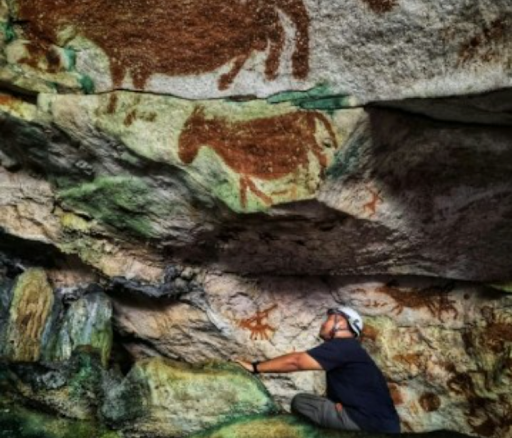

When researchers entered the limestone chambers of Sulawesi’s Maros-Pangkep region, it wasn’t just the human figures painted on the walls that transformed our understanding of early imagination – it was the animals.
Hidden beneath layers of mineral deposits, researchers uncovered a vivid ochre scene anchored by a powerful Sulawesi warty pig, its form rendered with striking attention and intention. Now dated to at least 51,200 years old, this animal-centered tableau is the oldest known figurative cave art on Earth.
The painting captures a moment of interaction between humans and wildlife, but the pig dominates the composition: alert, expressive, and unmistakably alive. Three stylized human figures surround it, their gestures suggesting movement, confrontation, hunting, or ritual. The warty pig’s grounding presence reveals how deeply early humans observed, revered, and narrated the lives of the creatures around them.
For decades, Europe’s Paleolithic caves- Lascaux, Chauvet, and Altamira- informed our assumptions about the origins of ancient symbolic art. However, discoveries like this show that Southeast Asia holds some of the earliest evidence of humans depicting the animals that shaped their world. Using refined uranium-series dating, researchers confirmed that this pig and its accompanying figures predate Europe’s earliest cave paintings by thousands of years.
This matters because it shows that storytelling with animals- through images, symbols, and shared meaning- was already central to human culture long before our ancestors spread across continents. Additionally, it underscores why conservation is urgent. Archaeological evidence shows that the people who painted these walls also hunted and ate Sulawesi’s warty pigs, relying on them as an essential source of food. The Maros-Pangkep karst region is a fragile archive where rising temperatures, deforestation, and quarrying threaten the very animals and landscapes that sustained these ancient artists.
The Sulawesi discovery reminds us that humanity’s earliest stories were animal stories. Pigs, buffalo, birds, and countless other species greatly influenced early human life and imagination. Protecting these ecosystems today honors that ancient connection and preserves the chapters of a story still being written- one in which humans and animals have always been intertwined.When researchers entered the limestone chambers of Sulawesi’s Maros-Pangkep region, it wasn’t just the human figures painted on the walls that transformed our understanding of early imagination – it was the animals.
Hidden beneath layers of mineral deposits, researchers uncovered a vivid ochre scene anchored by a powerful Sulawesi warty pig, its form rendered with striking attention and intention. Now dated to at least 51,200 years old, this animal-centered tableau is the oldest known figurative cave art on Earth.
The painting captures a moment of interaction between humans and wildlife, but the pig dominates the composition: alert, expressive, and unmistakably alive. Three stylized human figures surround it, their gestures suggesting movement, confrontation, hunting, or ritual. The warty pig’s grounding presence reveals how deeply early humans observed, revered, and narrated the lives of the creatures around them.
For decades, Europe’s Paleolithic caves- Lascaux, Chauvet, and Altamira- informed our assumptions about the origins of ancient symbolic art. However, discoveries like this show that Southeast Asia holds some of the earliest evidence of humans depicting the animals that shaped their world. Using refined uranium-series dating, researchers confirmed that this pig and its accompanying figures predate Europe’s earliest cave paintings by thousands of years.
This matters because it shows that storytelling with animals- through images, symbols, and shared meaning- was already central to human culture long before our ancestors spread across continents. Additionally, it underscores why conservation is urgent. Archaeological evidence shows that the people who painted these walls also hunted and ate Sulawesi’s warty pigs, relying on them as an essential source of food. The Maros-Pangkep karst region is a fragile archive where rising temperatures, deforestation, and quarrying threaten the very animals and landscapes that sustained these ancient artists.
The Sulawesi discovery reminds us that humanity’s earliest stories were animal stories. Pigs, buffalo, birds, and countless other species greatly influenced early human life and imagination. Protecting these ecosystems today honors that ancient connection and preserves the chapters of a story still being written- one in which humans and animals have always been intertwined.
RELATED READING | Abstracts of Recently Published Papers on Hunting & Conservation