
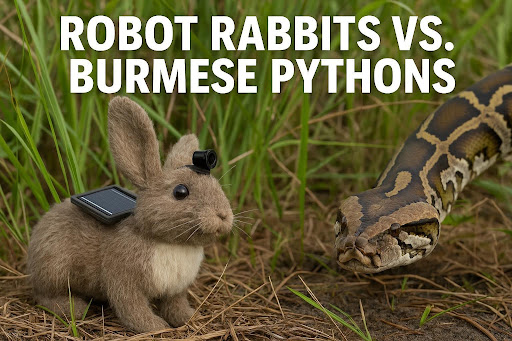

Can Robot Rabbits Help Save the Everglades?
For decades, wildlife managers in South Florida have been battling one of North America’s most challenging invasive predators- the Burmese python.
Now, in their efforts to remove the pythons from wildlife areas- they are testing an unexpected new tool: robot rabbits.
In the summer of 2025, researchers from the University of Florida and the South Florida Water Management District began testing solar-powered robotic rabbits designed to help locate invasive Burmese pythons in the Florida Everglades. The devices mimic living marsh rabbits by producing similar movement, heat, and even scent cues intended to attract the pythons. Cameras on the units alert biologists when a python approaches, allowing removal teams to respond.
A Predator That Doesn’t Belong
Native to Southeast Asia, Burmese pythons became established in South Florida through the illegal exotic pet trade. Since the 1990s, they have spread across much of the Everglade’s ecosystem.
Biologists estimate tens of thousands of Burmese pythons inhabit South Florida. More than 23,000 have been removed since 2000, but the species remains firmly established.
The Impact on Native Wildlife
The ecological damage from the Python’s presence has been significant. Research in South Florida has documented a major decline in native mammal populations such as raccoons, opossums, rabbits, and other small mammals.
The damage goes beyond any one species. As pythons reduce prey populations, the effects ripple through the food web, and leaves native predators such as bobcats, raptors, and the endangered Florida panther competing for dwindling food sources.
Why Robot Rabbits?
Wildlife managers use a range of tactics to control Burmese pythons, including removal contractors, public reporting, road surveys, detector dogs, radio telemetry, and the annual Florida Python Challenge.
Even so, finding the snakes remains one of the biggest challenges.
Adult Burmese pythons are notoriously hard to spot in dense vegetation, wetlands, and sawgrass marshes. Despite exceeding 15 feet in length, their camouflage helps them disappear into the landscape.
The robotic rabbits are meant to help solve that problem by drawing the invasive python into view.
The technology is still being evaluated, but early testing of the robotic rabbits has shown enough promise for researchers to continue using and improving the approach.
Conservation Takeaway
Invasive species management often requires creative solutions.
Robot rabbits may seem unconventional, but they represent a new approach in wildlife conservation: using science, technology, and innovation to protect native species and ecosystems.