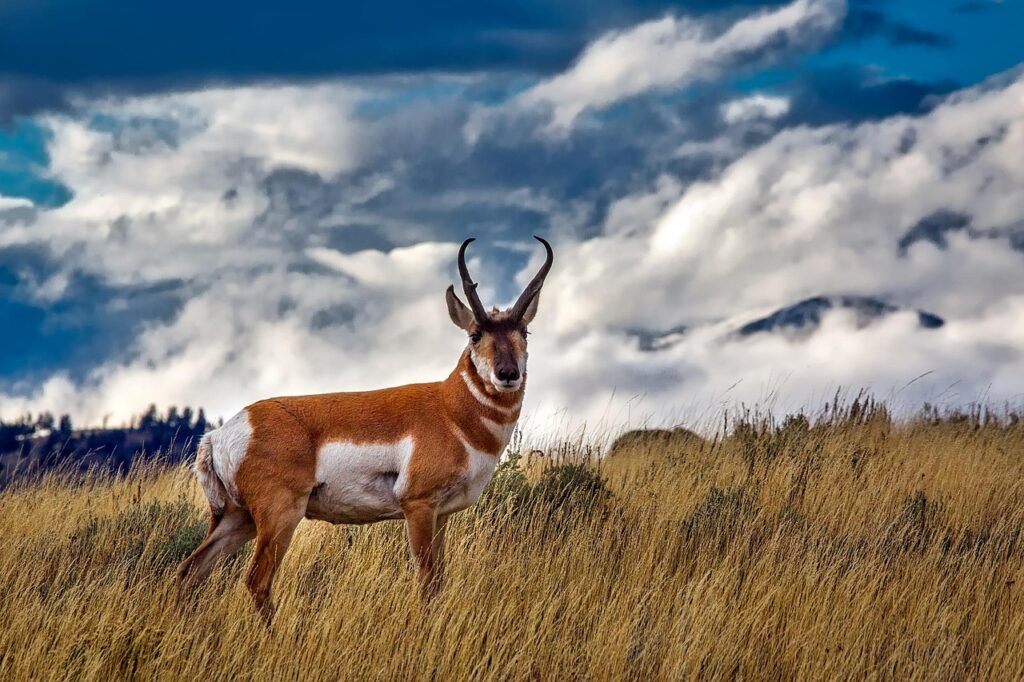

At the turn of the 20th century, pronghorn – known to many as “speed goats,” “sage rockets,” or loosely as antelope – were in free fall. An estimated 30–40 million once roamed from southern Canada to northern Mexico. By 1909, their numbers had plummeted to just ~5,000, largely due to ranching, homesteading, market hunting, and habitat loss.
1. Restore Habitat as a Foundation
Founded in 1887 by Theodore Roosevelt and a group of like-minded conservationists, the Boone and Crockett Club (B&C) is one of the oldest wildlife conservation organizations in North America. The Club has played a critical role in shaping modern conservation by promoting science-based wildlife management and habitat protection. True to that legacy, B&C began by investing in land to support struggling species like the pronghorn. In 1908, club members raised $600 to move pronghorn from Yellowstone to Wichita Game Refuge and another $3,000 to transport pronghorn from Alberta into Montana and South Dakota. Early relocation efforts failed – pronghorn are migratory and struggled in fenced refuges – but the Club remained undeterred.
The real breakthrough came when E.R. Sans sparked the idea for a refuge in northern Nevada. With the Audubon Society, B&C raised $20,000 total to buy 2,900 acres. President Hoover signed an executive order in January 1931 to establish the Charles Sheldon National Antelope Range, which grew to 851,000 acres today. That habitat now supports around 3,500 pronghorn, alongside sage grouse, mule deer, bighorn sheep, 849 plant species, and nearly 300 invertebrates.
2. Mobilize Animals Without Borders
Understanding migratory behavior was key. In 1937, thanks largely to the advocacy of sportsmen’s groups like the Boone and Crockett Club, Congress passed the Pittman‑Robertson Federal Aid in Wildlife Restoration Act. Rather than being a top-down government initiative, the Act was championed by hunters and conservationists who believed those benefiting from wildlife should help pay to restore it. It directed excise taxes on firearms and ammunition to be used specifically for habitat and species restoration – a groundbreaking move at the time. Within a decade, over 7,000 pronghorn had been captured and relocated by eight state wildlife agencies; another 5,000 were moved from 1949 to 1953. By 1954, pronghorn numbers reached approximately 273,000. By 1976, around 400,000. Today, populations sit at roughly 750,000 to 1.1 million, depending on the source.
3. Persevere Against New Threats
Despite this recovery, challenges remain. Many pronghorn herds migrate over 60–200 miles between seasonal ranges, but oil/gas fields, highways, solar and wind projects, and livestock fencing fragment their corridors. For example, the Sublette herd in western Wyoming – estimated at 35,000 individuals – must navigate industrial development in Pinedale Anticline and across highways.
Science and policy are tackling these obstacles head-on. The 2018 Secretarial Order 3362 funded 47 habitat restoration projects using $10.5 million in federal grants, matched by $54.5 million from partners. Efforts include wildlife overpasses (e.g. U.S. 191 at Trapper’s Point), fence modification, sagebrush restoration, and energy‑infrastructure planning informed by migration studies.
Relevant Reading | The Pronghorn Antelope Path: Securing Success in Wyoming
Takeaway
Pronghorn conservation stands as one of the greatest wildlife comebacks in North America. From fewer than 5,000 individuals in 1909 to nearly a million today, success came through land protection, strategic animal relocations, and ongoing policy‑driven restoration. It underscores the power of sustained action: habitats acquired, and policy innovation bolstered pronghorn from brink to resilience.
This is a conservation model worth replicating – and a story that reminds readers: when people commit with clarity based on science, species can flourish again.