
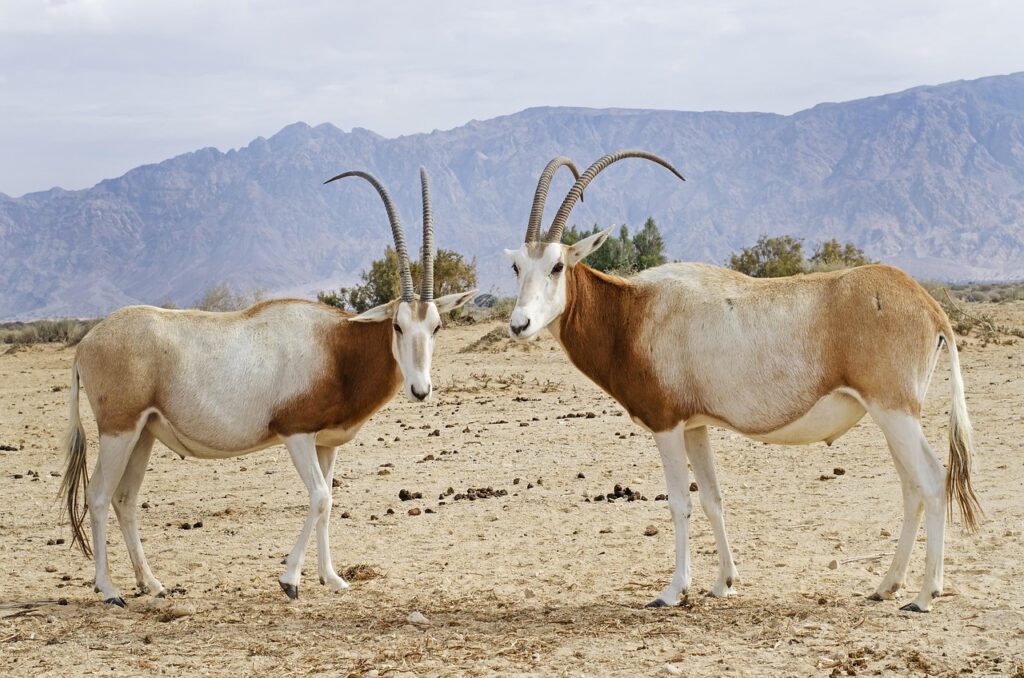

Just two decades ago, the scimitar-horned oryx – a desert antelope once widespread across North Africa – was completely gone from the wild. Overhunting and habitat loss had driven the species to extinction in its natural range, prompting the IUCN to list it as Extinct in the Wild by 2000. But today, in a world first for a large mammal, the oryx has been upgraded to Endangered, with over 600 individuals now roaming free in Chad. This unprecedented recovery is thanks to decades of coordinated zoo-based conservation and reintroduction efforts.
A Global Effort to Rebuild a Species
The oryx’s comeback is the result of a massive international collaboration. The Environment Agency – Abu Dhabi (EAD) spearheaded the creation of a genetically diverse captive population – the “World Herd” – sourced from over 220 zoos and breeding centers worldwide. This global gene pool laid the foundation for a long-term reintroduction strategy.
Returning to the Wild
In 2016, the first group of 25 oryx were transported to the Ouadi Rimé – Ouadi Achim Faunal Reserve in Chad – an area roughly the size of Scotland. Over the next seven years, multiple release waves followed. By 2023, more than 500 calves had been born in the wild, pushing the total wild population past 600. GPS tracking by conservationists from the Smithsonian Conservation Biology Institute and other partners helped monitor their survival and adaptation.
Zoos and Science Behind the Scenes
Zoos weren’t just holding facilities – they were vital players in advancing reproductive science. Institutions like the Smithsonian’s National Zoo developed assisted reproductive techniques, including artificial insemination, that helped increase genetic diversity and birth rates. These technologies ensured that the reintroduced population was both robust and genetically viable.
A Blueprint for Future Conservation
Despite this progress, the oryx’s future depends on continued protection, ecological monitoring, and collaboration with local communities. Poaching risks and habitat degradation still loom. However, the success of the scimitar-horned oryx is proof that extinction in the wild doesn’t have to be the end – it can be the beginning of a new chapter.
Relevant Read | Scimitar Horned Oryx—Five years on
The Takeaway
The scimitar-horned oryx is now one of the few large mammals to go from Extinct in the Wild to Endangered in just over 20 years. From zero to over 600 in the wild – that’s not just a recovery, it’s a revolution in conservation. This milestone reminds us that with global cooperation, science, and persistence, species once written off can thrive again.