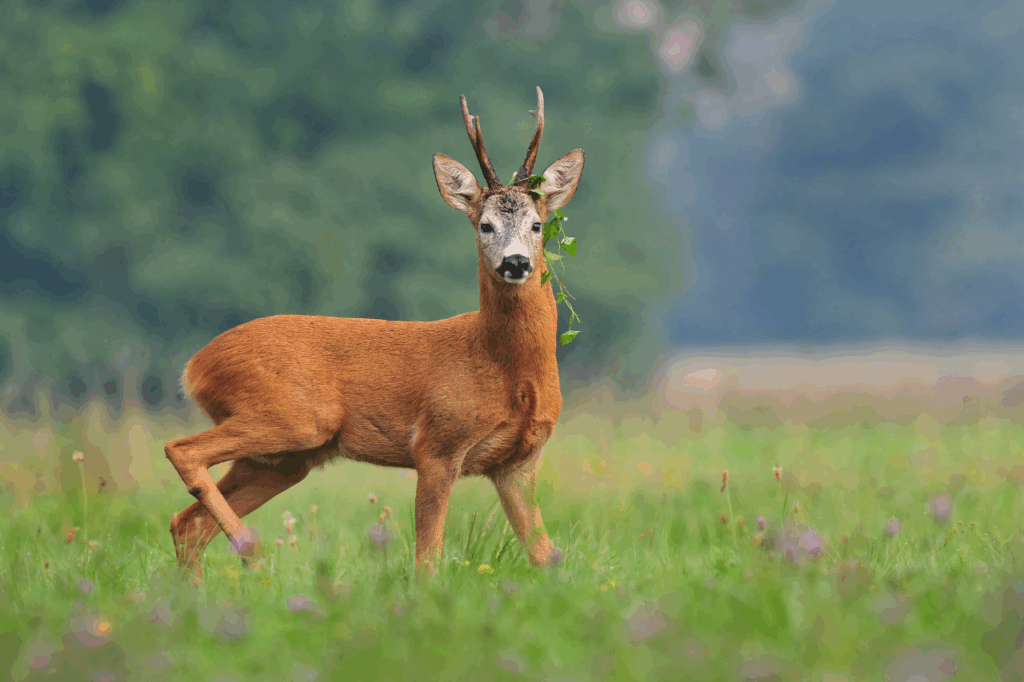

Deer populations in the United Kingdom have expanded rapidly over the past four decades. There are few places in the world better suited to deer than modern Britain with its mild climate, open countryside, no animal apex predators and few human hunters.
Driven primarily by six species now established across the landscape. Only red deer and roe deer are native. Fallow deer, introduced by the Romans, expanded under Norman land management, while sika, muntjac, and Chinese water deer arrived in the late 19th century following estate releases. A few centuries ago, deer were largely confined to deer parks, royal forests, and private estates controlled by a small, privileged class. After the First World War, many large estates fell into disrepair, park boundaries deteriorated, and deer populations gradually dispersed into the wider landscape.
Government agencies estimate Britain’s deer population may now reach two million animals, up from approximately 450,000 in the 1970s, according to the Forestry Commission. Growth accelerated following the Covid-19 pandemic, when population control declined significantly. Despite the annual removal of roughly 350,000 deer, Parliament was told in 2023 that up to 750,000 deer per year may need to be removed simply to prevent further population growth.
The impacts are widespread. The AA estimates up to 74,000 deer are killed or injured on UK roads annually, contributing to hundreds of human injuries and occasional fatalities. In forestry, high deer densities prevent natural regeneration by stripping bark and consuming new growth. Forestry and Land Scotland estimates £3 million per year in damage to young trees on public land alone. Agricultural losses can escalate quickly, with landowners reporting tens of thousands of pounds annually, and in some high-value crop systems, losses approaching £1 million per year.
Population management remains complex. Non-lethal tools such as fencing and fertility control face economic, logistical, and ecological limits at scale. Predator reintroduction is discussed in rewilding contexts but faces social resistance and would address only a fraction of annual population growth. Compounding the challenge, deer are legally classified as res nullius, meaning no single authority owns or manages them, leaving responsibility fragmented among landowners.
Key Data Points
- Estimated UK deer population: up to 2 million
- Population in 1970s: ~450,000
- Annual removals: ~350,000
- Estimated removals needed for stability: up to 750,000/year
- Road casualties: up to 74,000 deer annually
A central challenge in managing deer populations is that responsibility remains fragmented. Because control efforts are left to individual landowners, actions taken on one property can be quickly undermined by neighboring land where no management occurs, allowing deer to move freely across boundaries. This disconnect is most visible in Scotland, home to both large deer-stalking estates and major rewilding projects, where new legislation is advancing to strengthen coordinated population management in areas facing climate and biodiversity pressures. Elsewhere in the UK, governments acknowledge the issue but have yet to publish unified outcomes or enforce consistent strategies. Evidence from managed landscapes shows what coordination can achieve: where sustained population control has been applied, previously degraded ground has recovered, native plants and rare trees have returned, and insect and bird populations have increased. The outcome illustrates a broader conservation principle: when population pressure is addressed at the landscape scale, ecological processes reassert themselves, allowing habitats to recover on their own terms.
Conservation Takeaway
Deer are not inherently harmful, but unmanaged populations can reshape ecosystems, suppress woodland recovery, and amplify human-wildlife conflict. Where population pressure has been reduced, evidence shows rapid ecological response, including forest regeneration and increased plant, insect, and bird diversity. Effective conservation outcomes depend on coordinated, data-driven population management that reflects ecological limits rather than short-term or fragmented decision-making.