
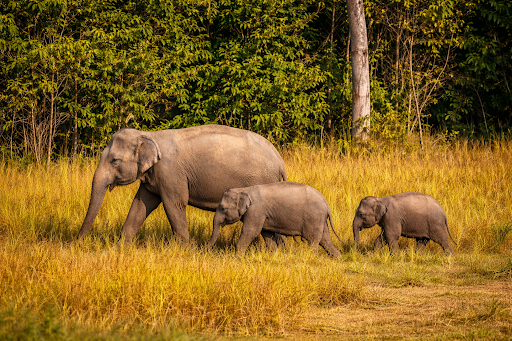

In wildlife management, birth control is rarely an effective tool. Across most species, it is difficult to administer, hard to scale, and has limited long-term impact. Thailand’s current approach represents a rare exception in wildlife management.
Last year in Thailand, wild elephants killed 30 people and damaged crops in more than 2,000 incidents. As elephant populations grow and forests shrink, elephants are moving closer to farms and villages, increasing the number of encounters with people.
To address this, officials are testing a birth-control vaccine in those areas. The vaccine is delivered remotely using dart guns, allowing wildlife teams to treat elephants without capturing or relocating them. It does not stop the elephant’s natural cycle but prevents pregnancy. One treatment can prevent reproduction for up to seven years. Without a booster, fertility returns. Officials will monitor vaccinated elephants as the program continues.
Related Reading | Failed Elephant Operation Leaves Community in Crisis
Where Elephant Conflicts Are Increasing
Thailand has about 4,400 wild elephants. In the country’s eastern provinces, where elephants frequently enter farms and villages, populations are growing faster than the national average. At the same time, forest habitat has continued to shrink and fragment, pushing elephants into closer and more frequent contact with people.
As agricultural land expands into traditional elephant range, crops like rice, sugarcane, and fruit become easy, high-calorie food sources. Elephants are highly intelligent and quickly learn these patterns, often returning to the same areas repeatedly.
Managing Risk
When wildlife populations grow beyond the space available, nearby communities feel the impact. In Thailand, residents are already experiencing the consequences. The challenge is how to respond.
Moving large wildlife is difficult and risky. A recent relocation effort resulted in the death of one elephant during anesthesia. Fencing and patrols can reduce encounters, but they require constant maintenance and do not solve long-term population growth.
Fertility control offers a different approach. It does not remove animals from the landscape but instead slows future population growth in high-conflict areas. This method is highly unusual and has only shown limited success outside of a few species, including elephants.
Conservation Takeaway
Birth control in wild populations is rarely effective and difficult to apply at scale. Thailand’s use of fertility control in elephants is a unique case, not a standard model.