

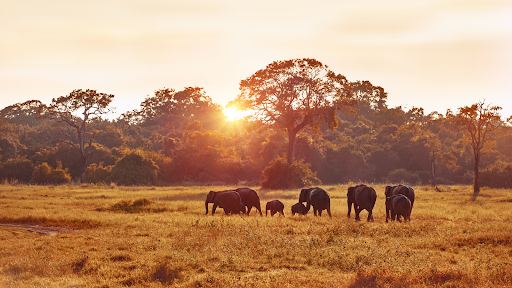
Coutada 11 is one of Mozambique’s most remarkable wildlife areas — a vast conservation and safari concession located within the Marromeu Complex, in central Mozambique’s Sofala Province. Spanning nearly 1,928 km² (about 500,000 acres), Coutada 11 lies roughly 30 miles inland from the Indian Ocean and is bounded to the north by the mighty Zambezi River.
Historically, this region boasted some of Africa’s richest biodiversity. However, decades of civil war (1977–1992) decimated wildlife populations, reducing buffalo and other iconic species to dangerously low numbers. In the post-war years, the landscape was described as a “poached-out wasteland” until concerted restoration efforts began in the early 1990s.
A Conservation Comeback
Since 1992, the concession on Coutada 11 has been managed by Zambeze Delta Safaris, which took on the challenging task of rebuilding the ecosystem. Over the past three decades, their antipoaching and wildlife management programs have helped wildlife numbers rebound dramatically. Today the area hosts 21 game species, including four of Africa’s famous Big Five (buffalo, elephant and more), thriving across a mosaic of habitats such as Miombo woodlands, floodplains, tropical savannah, sand forests, and swamps.
The success of this transformation has drawn international praise.
As one conservation article noted, despite minimal media recognition the restoration of Coutada 77 is one of Africa’s most outstanding conservation achievements – proof that with vision commitment and practical strategies even seemingly lost wilderness can thrive again.
Community and Anti-Poaching Efforts
Central to Coutada 11’s resurgence has been its anti-poaching unit, which combines local hiring and training with strategic patrols across rugged terrain. A report on the concession’s protection efforts explains how these teams actively disrupt poaching networks, and emphasizes that: Without the financial input from international hunters Coutada 77 concession would return to the poached out wasteland it was 96 plus years ago.
These programs also include community engagement, distributing protein from lawful harvests to nearby villages and supporting agricultural initiatives to reduce local reliance on bushmeat.
Modern Safari and Wildlife Experience
Today, Coutada 11 is regarded by many experienced safari hunters and ecotourists as a destination that combines free-range wildlife experiences with an authentic African wilderness feel. Reports from recent safari visitors describe diverse game encounters and the raw beauty of landscapes seldom seen elsewhere.
Whether viewed through a conservation lens or as an adventure destination, Coutada 11’s resurgence stands as a powerful example of how long-term commitment, community roles, and sustainable funding can help restore even heavily damaged ecosystems.
The takeaway is straightforward:
Wildlife rebounds when it has both protection and economic value. Coutada 11 is a working model for conservation in regions where wildlife must compete with real human pressures.