
This article is Part I of a two-part series on the history of the American bison.
“Buffalo” and “bison” are often used interchangeably in North America. Early explorers called it “buffalo,” and the name stuck.
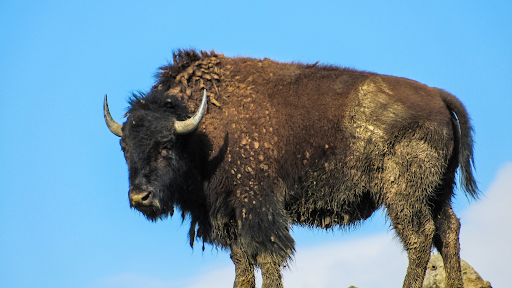
Archaeological evidence shows Indigenous peoples hunted bison for at least 10,000 years, during a time when an estimated 30 to 60 million bison roamed North America. These vast herds shaped the Great Plains ecosystem and sustained Indigenous communities. They also transformed the landscape by carving out trails that later became routes for pioneers. Across the Plains, layers of bison bones preserved in archaeological sites point to a long, shared history between people and bison on this land.
Spanish explorers in the 1500s described enormous “wild cattle” moving north from Mexico into what is now Texas and the Southwest. By the 1700s, French traders traveling through the Mississippi Valley and Canadian plains wrote about herds so large they darkened the horizon. By the time Europeans recorded the animal, Indigenous nations had already built societies around the buffalo.
A Moving Civilization
For many Plains tribes, including the Lakota, Cheyenne, Blackfoot, Kiowa, Comanche, Arapaho, and Crow, the buffalo was not just food, it was the foundation for their way of life.
Life followed the buffalo’s migrations, with camps set along well-known routes. Communities tracked calving seasons and grass cycles, while knowledge of river access and herd behavior was passed down through generations.
When the buffalo moved, people moved. The arrival of the horse, introduced by the Spanish in the 1600s, expanded that mobility. Tribes such as the Comanche became highly skilled mounted societies. Horse culture strengthened the relationship between people and bison and allowed larger territories to be hunted and managed.
Nothing Wasted
Harvesting bison played a central role in many plains tribal communities. The animal provided food, materials for clothing and shelter, and tools, while other essential needs like water, fuel, and plant resources were gathered from the surrounding landscape. Every usable part of the bison was put to work, reflecting a deep respect for the resource.
Food
- Fresh meat roasted or boiled
- Dried meat and fat combined into pemmican for winter or long travel
- Organs consumed for immediate nutrition
Shelter
- Hides formed tipis engineered for mobility
- Winter robes made from thick hides with fur intact
Tools and Weapons
- Bones shaped into knives, scrapers, needles, and awls
- Shoulder blades used as digging tools
- Horns carved into cups and spoons
- Sinew twisted into cordage and bowstrings
- Rawhide used for shields and lashings
Clothing and Protection
- Tanned hides became leggings, moccasins, and gloves
- Fur-lined robes insulated against prairie winters
Trade and Economy
- Surplus hides and crafted goods traded between tribes
- Buffalo products functioned in exchange networks
Even stomachs were used as cooking vessels. Hooves were boiled down into glue. This was a zero-waste system long before sustainability became a slogan.
The Science of Sustainability
Researchers estimate that before European settlement, bison populations ranged between 30 and 60 million animals. Migration routes were followed and respected. Fire stimulated fresh grass growth. Constant movement prevented overuse of any one area. Hunting was based on need.
The relationship between people, buffalo, and grass was dynamic but balanced. People depended on buffalo. Buffalo depended on grass. Grass depended on grazing, hoof action, and fire.
This was the Great Plains before railroads, barbed wire, and industrial markets reshaped the landscape. Before the prairie was divided. Before migration corridors were cut off. Before extraction outpaced renewal, millions of bison moved across the land, shaping the soil and sustaining entire communities.
Part II in this series continues the story, examining what changed when railroads, industrial markets, and new technologies transformed the Plains and the future of the bison.