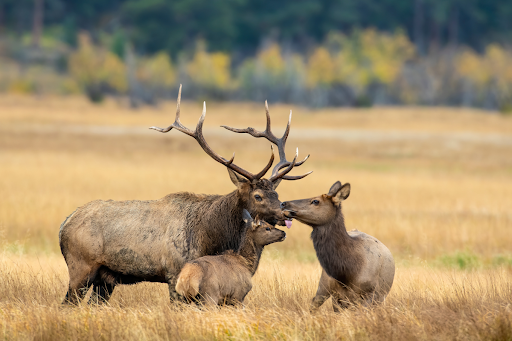

In northwestern Wyoming, one of North America’s largest elk herds is already on the move — weeks ahead of its traditional spring migration schedule.
According to recent observations from Grand Teton National Park and the National Elk Refuge near Jackson, thousands of elk began leaving winter range unusually early this year following an exceptionally mild winter with reduced snowpack and warmer temperatures. Traditionally, large-scale migration movements into the Tetons begin in mid-to-late spring. In 2026, some elk started moving as early as January.
The Jackson elk herd is one of the most recognizable migratory elk populations in the American West. Roughly 6,500 elk winter on the National Elk Refuge before dispersing north into Grand Teton National Park, Yellowstone, and surrounding high-country habitat as snow conditions change.
This year, however, snow conditions across portions of western Wyoming remained dramatically below average deep into winter. Refuge monitoring data from February showed snow depth nearly 90% below long-term averages in some areas, while forage conditions remained sufficient enough that supplemental feeding operations were delayed.
Wildlife managers are paying close attention.
Early migration itself is not necessarily harmful. Elk naturally respond to changing environmental conditions, particularly snow depth and forage availability. But increasingly irregular winter conditions are raising broader questions about how warming winters and altered seasonal timing may affect long-term migration behavior, habitat use, and herd distribution across the Greater Yellowstone Ecosystem.
The issue extends beyond the animals themselves.
Earlier migrations also increase the risk of wildlife-vehicle collisions as elk, mule deer, and pronghorn move across roads and developed corridors earlier in the year than drivers may expect. Grand Teton National Park officials have already urged motorists to remain alert during migration activity throughout the region.
Researchers are also continuing to expand wildlife tracking efforts throughout the Greater Yellowstone region. Several elk within the Jackson herd were recently fitted with GPS collars to better understand changing migration timing and movement patterns.
Across the American West, conservation conversations surrounding elk are increasingly shifting toward migration connectivity and adaptive management rather than simple population recovery. Many western herds remain healthy, but the landscapes they depend on are changing. Development pressure, recreation, highways, fencing, and shifting seasonal weather patterns are all influencing how and when animals move across the region.
The Jackson herd remains one of the clearest examples of how tightly western wildlife management is tied to landscape conditions. Elk still move with the seasons, but the seasons themselves may be changing. The reintroduction of wolves across parts of the Greater Yellowstone ecosystem has also reshaped elk behavior, migration patterns, and herd distribution, adding another layer to an already complex balance between predators, habitat, drought, winter severity, and human pressure.
Conservation Takeaway
Migration timing is becoming an increasingly important part of western elk conservation as wildlife managers adapt to changing winter conditions and shifting movement patterns.