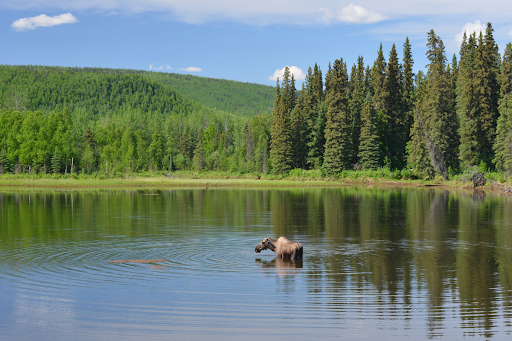

For many rural communities along Alaska’s Lower Yukon River, moose are more than a wildlife resource. They are a critical source of protein in a region where store-bought food is expensive, transportation is difficult and subsistence hunting remains central to daily life.
That makes the growth of the Lower Yukon moose population especially significant. Moose were scarce across much of western Alaska during the early 1900s, but over several decades they expanded into new areas and increased substantially across parts of the Lower Yukon region.
From Scarcity to a Dependable Food Source
The recovery did not happen quickly. Productive habitat, conservative harvest management and continued monitoring allowed the population to grow over time.
Today, an estimated 700 to 800 moose are harvested annually. Wildlife managers familiar with the region estimate that roughly 90 to 95 percent of that harvest is taken by local Alaska Native and other rural residents for subsistence use.
For these communities, a successful moose harvest will provide hundreds of pounds of meat and help feed an extended family through much of the year.
Managing a Growing Population
Wildlife managers use aerial surveys, harvest reports and field observations to track moose abundance, distribution and population health.
The management objective is not simply to produce as many moose as possible. It is to maintain a healthy population without exceeding the limits of available winter habitat, while also supporting dependable subsistence harvest.
Habitat Supported the Recovery
Moose rely on young willow, birch and other woody vegetation for food. Flooding, wildfire and shifting river channels regularly disturb the western Alaska landscape, producing the young vegetation moose need. These habitat conditions created room for the population to expand while careful harvest decisions helped protect that growth.
Conservation With a Direct Human Benefit
The Lower Yukon moose recovery is a practical example of conservation supporting both wildlife and people. A once-limited population now provides an important and renewable food source for rural communities that continue to depend on the land.