
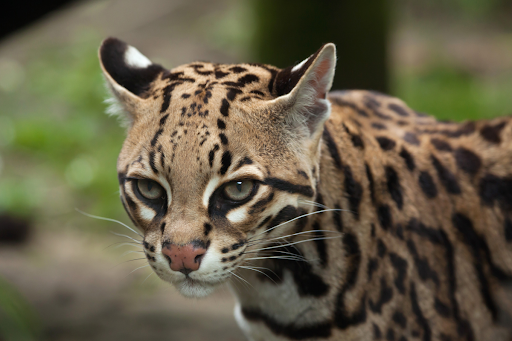

Fewer than 100 ocelots are believed to remain in the United States, with the surviving population concentrated in South Texas.
These small wild cats depend on dense native thornscrub for cover, hunting and reproduction. Over time, much of that habitat has been cleared or fragmented by roads, development and other land-use changes.
Three Interesting Facts About Ocelots
- Every ocelot has a unique coat pattern. No two animals have the same arrangement of spots, stripes and rosettes. Those markings also provide effective camouflage in dense vegetation.
- Ocelots are primarily nocturnal hunters. They rely on strong night vision, sharp hearing and stealth to hunt rabbits, rodents, birds, reptiles and other small prey.
- They also once ranged across a much larger portion of the southern United States. Today, wild ocelots are found mainly in Central and South America, while only a small population remains in South Texas.
A New Research and Breeding Facility
Scientists at the Caesar Kleberg Wildlife Research Institute at Texas A&M University-Kingsville, working with partners including the East Foundation, are committed to restoring ocelots to portions of their former range and securing their future in the United States.
A new facility will allow researchers to study ocelot health, genetics, behavior and reproduction in greater detail. It will also create the capacity to produce animals that could eventually support reintroduction efforts and strengthen existing wild populations.
Sixteen separate ocelot enclosures will provide approximately 19,250 square feet of indoor and outdoor space. Those enclosures will accommodate breeding males and females, mothers with young offspring and animals undergoing quarantine.
Research Built on Years of Fieldwork
Researchers at the Caesar Kleberg Wildlife Research Institute have studied South Texas ocelots for years. Their work has helped wildlife managers better understand how the cats move across the landscape, use available habitat and respond to changes in land use.
That research is critical because habitat restoration alone may not be enough to recover a population this small and isolated. The new facility represents an important step toward giving one of North America’s rarest wild cats a better chance at recovery.