
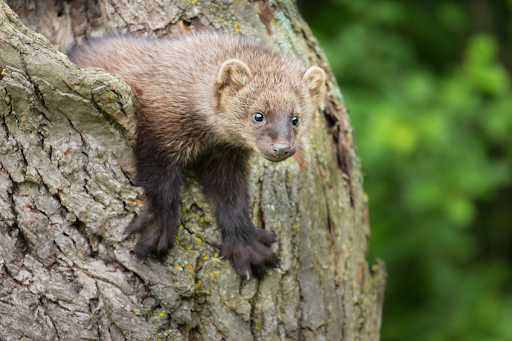

Fishers are secretive forest carnivores in the weasel family. Despite their name, they do not primarily eat fish. They are known for climbing trees, moving through dense forests and being one of the few predators capable of regularly killing porcupines.
Connecticut reintroduced fishers in 1988, and the species eventually became established across much of the state. More recent research suggests their distribution may be uneven, particularly in western Connecticut.
Three Interesting Facts About Fishers
- Fishers are not cats | They are members of the weasel family and are closely related to martens, otters and wolverines.
- They are excellent climbers | Fishers have strong claws and flexible ankles that allow them to climb trees and descend headfirst.
- They eat more than porcupines | Their diet can include squirrels, rabbits, mice, birds, insects, fruit and carrion.
What Recent Research Found
Researchers reviewed winter camera surveys conducted across Connecticut from 2018 through 2023. The results showed that fishers remain present across much of the state, but detections were lower in some western areas, especially southwestern Connecticut.
Because fishers are secretive and occur at relatively low densities, not photographing one does not necessarily mean it is absent.
Why Their Distribution May Be Uneven
Fishers were more likely to be found in areas with greater amounts of coniferous habitat.
They can also live near developed areas, but roads, development and fragmented forests may make it harder for them to move between feeding, resting and denning areas.
The findings reinforce the importance of maintaining forest cover and connections between larger habitat areas.
What Comes Next
The research does not show that fishers are disappearing from Connecticut. They remain established across much of the state. Continued monitoring will help wildlife managers better understand how Connecticut’s fisher population is changing and whether any management response is needed.