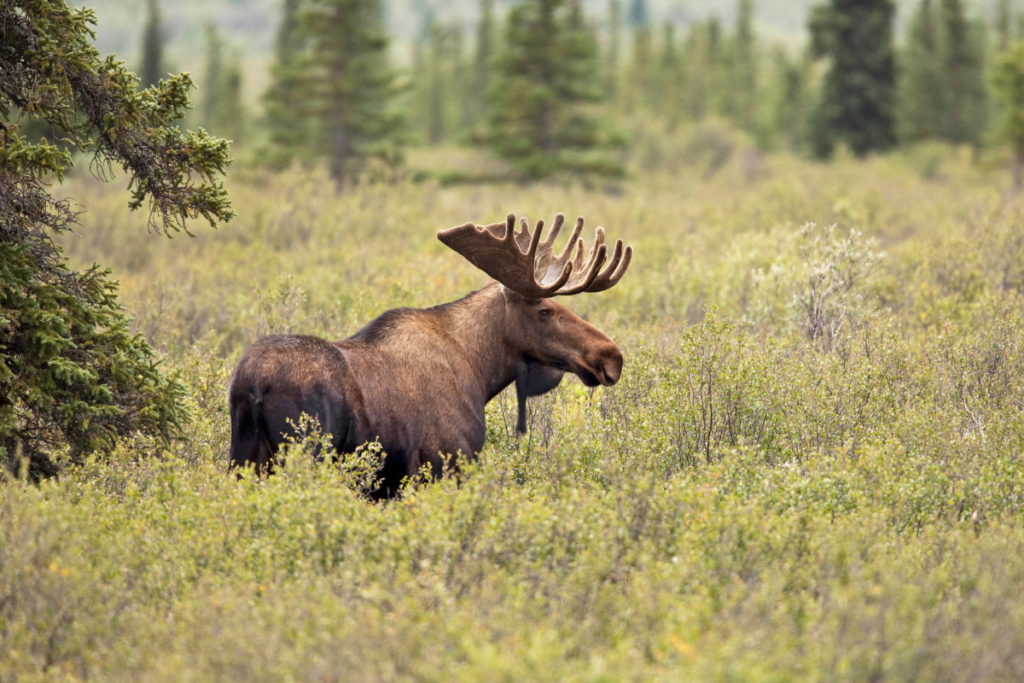

Minnesota’s largest wild animal is built unlike anything else in the state. A mature moose can weigh more than 1,000 pounds, stand over six feet at the shoulder and dive underwater for food.
1. Moose Are Built on an Extraordinary Scale
An adult Minnesota moose can weigh as much as four or five mature white-tailed deer combined. Moose have long legs and towering shoulders allowing them to move through deep snow, wetlands and dense northern forests that would slow smaller animals.
2. Moose Can Swim 10 Miles and Dive for Food
Moose are powerful swimmers capable of covering as much as 10 miles without leaving the water. During summer, they also dive to the bottom of shallow ponds and lakes to pull up aquatic plants.
On land, moose browse on willow, aspen, maple, cherry and other trees and shrubs. Their stomachs can hold more than 100 pounds of food.
3. Bulls Grow a New Set of Antlers Every Year
Bull moose begin growing antlers each spring. A mature bull’s antlers can span approximately five feet and weigh as much as 40 pounds.
During the fall breeding season, bulls use their antlers to establish dominance by fighting with competing bulls. They shed their antlers in December or January, and the growth process begins again the following spring.
4. Moose Calves Can Swim Within Their First Week of Life
Female moose generally give birth in May or June to calves weighing only 25 to 35 pounds. Within approximately one week, a newborn calf is strong enough to walk and swim.
Despite developing quickly, calves remain vulnerable. Minnesota DNR research found that about 35% of monitored calves survived to nine months of age. An average of 38% of recorded calf mortality occurred during the first 30 days after birth.
5. Wolves Are the Leading Predator of Minnesota Moose Calves
In the period of the Minnesota DNR study, predation was consistently the leading cause of calf mortality. Wolves accounted for about 67% of calf deaths. Black bears accounted for another 15%.
GPS tracking showed that calving sites offered calves relatively safe cover. Predator kills generally occurred after cows and calves moved away from those sites, showing how the location of forage, concealment and escape terrain can affect calf survival.
Even Minnesota’s Largest Wild Animal Is Vulnerable
Calf survival is only one piece of a larger picture. Minnesota’s moose population fell from an estimated 8,000 animals in 2009 to roughly 4,470 in 2026, though the DNR reports the decline has leveled off in recent years. Wildlife managers point to no single cause — habitat loss, parasites and predation on calves all factor into the species’ long-term outlook.